12-16th September, 2022
- Introduction.
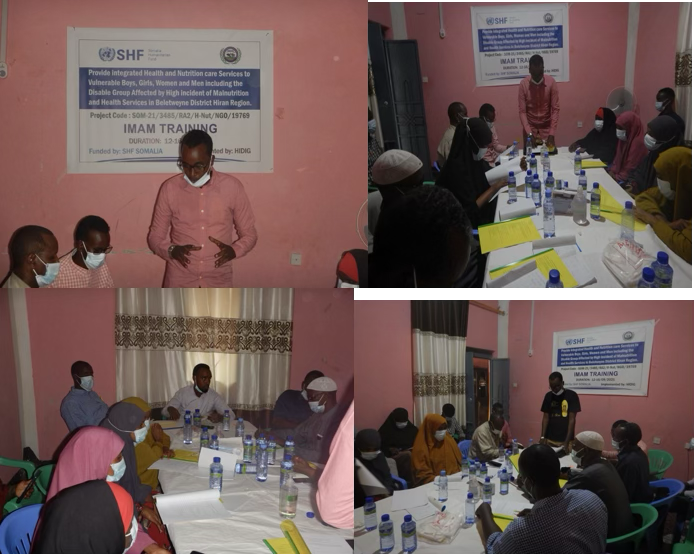
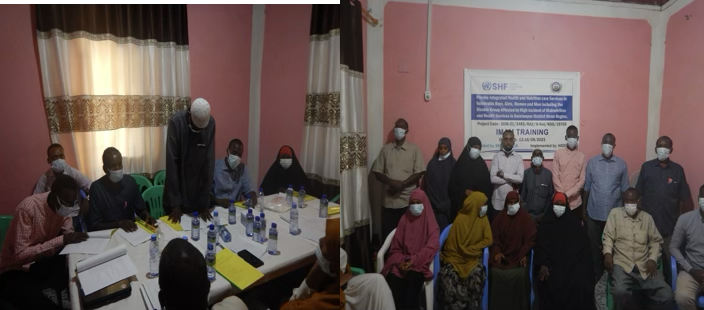
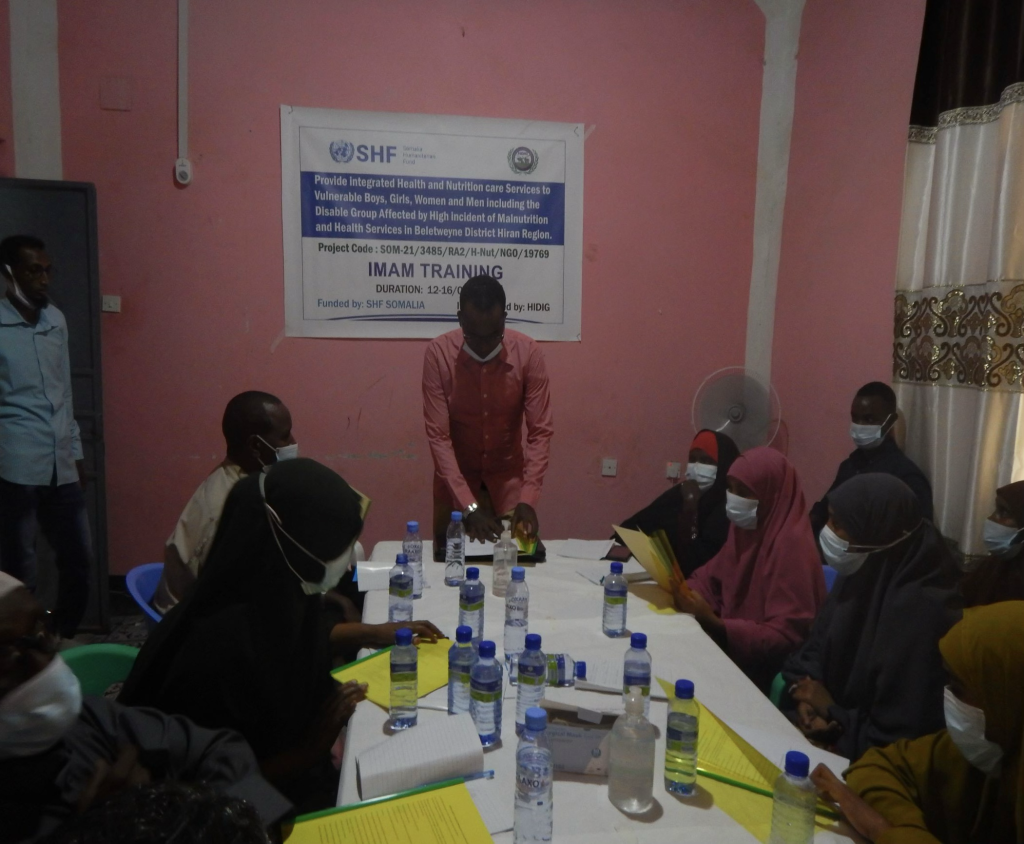
HIDIG conducted IMAM training for key nutrition program staff and community health workers in Baladweyne District Hiran Region of Southern Somalia. The nutrition staff received the 5 days IMAM Nutrition training.The training is part of a larger capacity building program that is funded by SHF Somalia and redesigned to suit nutrition staff needs in the wake of the current program in Somalia. Basically, the training followed the Guidelines for managing malnutrition in Somalia, however it was tailor made for nutrition staff offered in Somali and trainings materials were developed by HIDIG program manager with inputs from SHF field team.
A total of 33 participants took part in the training, the training team from HIDIG consisted of one trainer with lead trainer (consultant), the training coordinator and HIDIG nutrition officer, the training employed participatory approach which is vital in the art of adult learning (andragogy) therefore opinions, knowledge of the working situation and environment in Somalia was put into consideration.
1.1. OBJECTIVES
The broad objective of the training was;
- To provide health workers with information on outpatient therapeutic feeding program to understand its place in the nutrition and health system in order to strengthen its support.
Specific objectives;
- To have an in-depth understanding of IMAM implementation modalities.
- Discuss its operationalization in Somalia Context.
1.2. Participants’ orientation and course introduction.
The training started with welcoming, climate setting and introductions lead by the HIDIG team. Participants gave a brief introduction of themselves which gave a basic understanding of their experience, capacity and nutrition knowledge. After climate setting and introductions, a pre- test was administered, in the pre- test the trainees were advised against writing their names on the test paper but were rather given a set of numbers to randomly choose a unique number for each of the participants they were further told to retain this number and not to reveal it to others this will help in gauging the pre- test against the post-test without revealing the true identity of the participants.
Training content.
Day 1&2 : (12th-13st Sept, 2021)
- UNDERSTANDING MALNUTRITION
- causes of malnutrition
The facilitators and the participants brainstormed on the causes of malnutrition, the participants were grouped and asked to list the common causes of malnutrition in the area in no systematic order then from their listing the facilitator was able to come up with the conceptual framework and explain the basic, underlying and immediate causes of malnutrition and how the three are interlinked to the understanding of the participants
The participants were also taken through the different types of malnutrition focusing on the most common in Somalia and which most intervention in the area aim to reduce its magnitude, they were also taken through the different management options to give them a broad understanding of malnutrition and its management before zeroing in on moderate acute malnutrition and the objective of the training.
Most of the participants had an understanding of malnutrition, the vulnerable groups but weren’t adequately informed of the different management options and the different programmes aimed at managing malnutrition therefore little understanding of IMAM components. There was also confusion on the differences between SC AND OTP with most of the participants mistaking TSFP for OTP but the trainer was able to clarify on the same giving the participants the comparisons and the differences between the two programmes
2. Admission, discharges and referrals
The trainees exhibited difficulty in identifying the criteria for admission and discharge from OTP as well as referral criteria despite most of them having worked actively in OTP programs. At the beginning most of them expressed difficulty in using the standard deviation this did not persist after the interactive and full of exercise session on the same.
3. Anthropometry
This topic entailed taking the participants through the processes and procedures of taking weight, height and MUAC and also on how to check oedema. The participants contributed and participated in the session on anthropometry explaining real scenarios they encounter in the course of their activities and how they overcome such scenarios. Participants were not familiar with the mother and child weighing scale but were given on to the point explanations and demonstration with more practical part anticipated for the following day.
4. Diagnosing malnutrition
On the afternoon of day 1 of the training the participants were taken through how to diagnose SAM cases through identifying the signs and symptoms of malnutrition and also by calculating and computing Z scores. There was also a simulation exercise on Z score finding which made the session interesting. The participants were at the end of the day given exercises to work on overnight and present individually in the morning.
DAY3: (14nd Sept, 2021)
3.0: practice of anthropometry, medication and community mobilization
Day 2 started with a recap of the activities of day 1 and the topics learnt, thereafter the participants made presentation of the exercise they were given at the end of day with presenters randomly selected and recorded to ensure that there was no bias and each of the participants made presentations by the end of the training.
- Routine medication in OTP and BNSP
For close to an hour, the participants were taken through the routine medication in OTP, it was observed that they had an understanding of the major drugs and medications given but were not adequately informed on the dosages therefore stimulation exercise and home work was given to give more focus on the topic and make them understand the dosage better.
2. Practical session.
After the presentations the practical started with a group of mothers and their children, the participants were divided into four groups of six members equipped with anthropometry tools (weighing scale, MUAC tape, height board) and four mothers and their children were also assembled each strategically placed such that each group would perform anthropometry with
each child and pass over to the next group such that by the end of the practical each team would have done anthropometry on each of the children with the supervision of the training team.
The purpose of these was to put into practice what was learnt theoretically and also guide through the process of taking measurement, identifying common mistakes and rectifying the mistakes. A child above five years of age was included in the children coming for the practices to gauge whether the teams were attentive and whether they would identify that the child wasn’t eligible for any programme. This session was quite crucial in determining the participants’ week points and strengths and support was given accordingly.
3. Feedback, discussion on the anthropometry practical.
After the practical session the participants were required to give feedback of the practical exercise, the measurement they got, find the z-scores and which program the child would be eligible to be enrolled in. Each group picked one person to present their results.
The results presented by the different groups had very slight variations, with the acceptable difference of plus or minus 0.1cm 0r kg except for one team that had deviated slightly above the acceptable limits. All the teams were able to calculate the Z scores correctly and identify the appropriate program based on their Z score findings. In the discussion the training team discussed with the participants some of the most common mistakes observed in the course of the practical which are listed below
Common mistakes identified during the practical.
- Not locating the midpoint correctly in taking MUAC.
- Taking weight while child is wearing heavy cloth.
- Doing MUAC on the right hand.
- Reading the MUAC tape upside down.
4. Community mobilisation
The topic was introduced by asking the participants to list the challenges faced in implementing in groups taking the sites they work in as an example. They thereafter made presentations of the same and it was found from their discussions that it was coming out as a solution to their challenges. Importance and steps of community mobilization was discussed in detail to address its role in implementing lifesaving nutrition interventions.
Day 4&5:(15nd-16rd Sept, 2021)
- Operationalization, stock management and performance indicators.
Day 3 started with a recap of the activities of day 2 followed by presentation of the simulation exercise and homework on the topics covered on day 2 dwelling much on routine medication and the importance of community mobilisation
- 2. Reporting
Participants were taken through the reporting tool, step by step with practical using practical data from their respective sites as examples; this was done in smaller groups as facilitators split among the groups and finally a global presentation done. Most participants mentioned that they send raw to data to Nairobi and the reports are prepared in their absence.
3. supplies, ordering and control.
Emphasis was made on estimating supply needs/consumption from the monthly reports, warehousing and storage of supplies including stock control and keeping an inventory of all the supplies.
- monitoringof OTP.
Participants were taken through performance indicators of the NHHP, with practical component of the monitoring on what to do under what indicators.
4.3: Effectiveness of the training and quality assurance.
The effectiveness of the training was estimated against the knowledge increased and level of attitude change. To measure the increase in knowledge and attitude change, the pre and post test results as well as the participation in group discussions and regular practical exercises were used as indicators.
- Pretest and posttest results.
The pretest showed an average performance of 18.6% among the 28 participants. Results shown detail in Annex 3. The performance in the Post test was an average mark of 61% showing an average performance improvement by 42.4%.
- Group exercises.
From the exercises given for group discussions it was equally clear that learning had taken place since the participants exhibited knowledge and competency. Group discussions, class exercises and evening exercises were the main interactive methods used during the training which led to presentations by the groups or individuals assigned. During the presentations, participants exhibited competency in the subjects under their debate.
- Awarding certificates.
Having covered the components of the training as scheduled and participants showing a satisfactorily understood the content delivered to them, the training participation certificates to the trainees. This was followed by a vote of thanks from both the trainees and the trainers.
6.0. Recommendations based on the evaluation of training/education.
- To avail soft refreshments for the participants without deducting from the communicated per day allowance. Participants seeking breaks from outside the training hall led to loss of time as they dint necessarily take refreshments from the same place.
- Partners should be encouraged to balance the number of participants by gender.
- Participants requested to be given per diem on the two travel days as their night lodging and meals were not covered on the two days of travel while others took even more days to reach the training venue.
Follow up action plan.
In order to contribute further to the projects objectives participants were encouraged to compare in groups their practice at work and the learned standard practice as per the guidelines and to discuss what were the necessary adjustments to be made.
Furthermore, trainees were given hand-outs and field cards which were necessary to use as wall posts and enhance adequate practice of protocol.
Training Photos