19-23th September, 2022
- : Introduction.
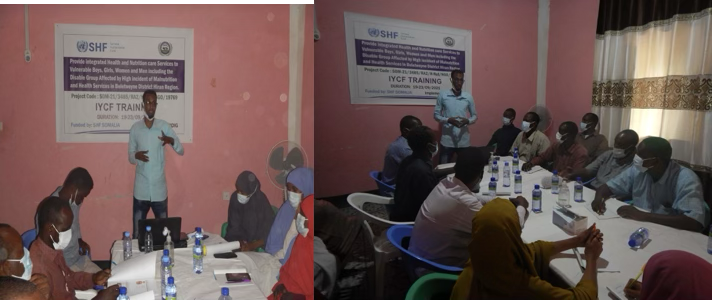
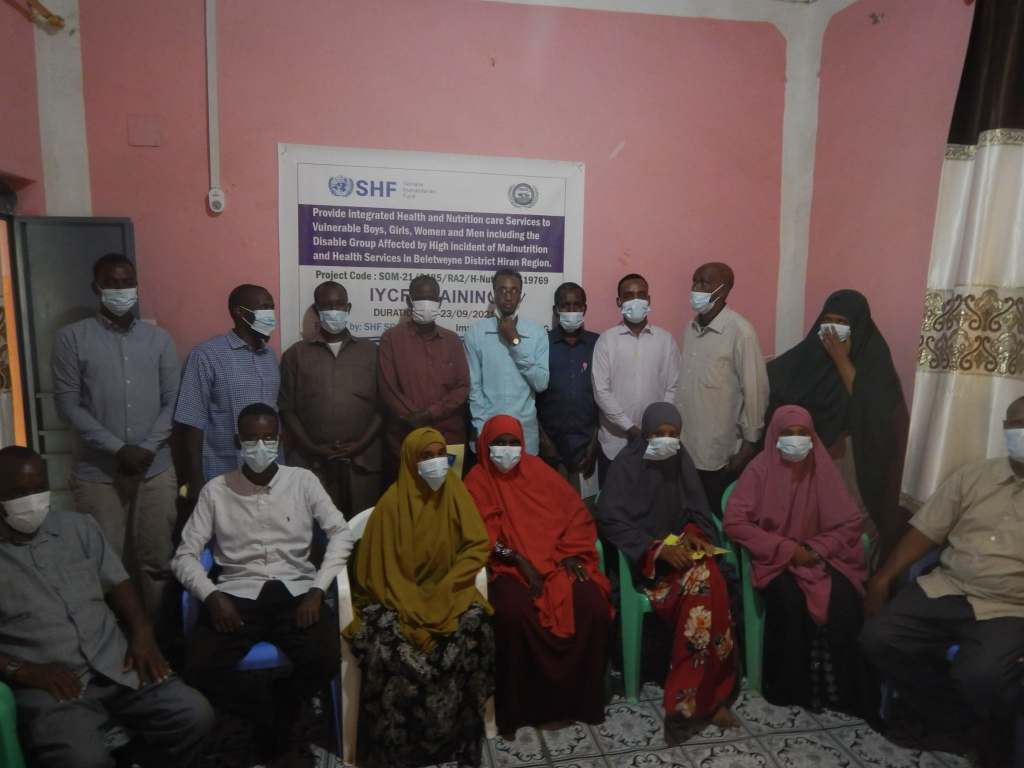
HIDIG conducted five days IYCF training for key nutrition program staff and community health workers, community members and Local administrators in Beledweyne district Hiraan region of Hirshabelle Somalia. This was aimed at providing the staff and the other program team an insight of the IYCF in order to equip the field staff the necessary capacity in the area of nutrition, health and hygiene promotion. The training was also to emphasize the importance of having a strong link between IYCF programming in non-emergency and emergency contexts and encourage strong operational action plans among and between the field staff that are involved in nutrition and health in order to ensure that the theory is put into practice.
A total of 33 participants drawn from various HIDIG nutrition sites in Baladweyne took part in the training, the training employed participatory learning approach which is vital in the art of adult learning (andragogy) therefore opinions, knowledge of the working situation and environment in Somalia was put into consideration.
- OBJECTIVES
The broad objective of IYCF campaign
- Promotion of IYCF key messages among the various communities and stakeholders in Baladweyne project area.
Training content
- Community mobilization using public address.
HIDIG community mobilizers were given microphones to make announcement of the public gathering at HIDIG organization Baladweyne MCH for IYCF talks. The community mobilizers informed the public on the day schedules through staging them in a different point in Baladweyne town.
2. Welcoming notes from HIDIG program manager to the event.
The program manager welcomes the Baladweyne local authority administrators to officiate the event.
3. Local authority official message.
The administrator welcomes the community members and appreciated their willingness to get health and nutrition education information, he advices the gathering by to be steadfast in ensuring that the take their children to the locally available public health institution to get the
right treatment. The administrators open the event officially and advice HIDIG management to continue the good thing they doing with the community.
4. Community IYCF education address from HIDIG nutrition officer.
The program officers enlightened the community members on the important of the infant feeding and explore more on the three main component of IYCF that is earlier initiation of breast milk to the infant and health significant of such initiation to the infant, He also make mothers understand the mothers on the aspect of hygiene that is required in ensuring that their newborn babies remained healthy. The program officers also let the mothers to understand complementary feeding to their young once as well as the diversification of the right food for the child. The even was later culminating with ululation of the mothers having grasped the basic IYCF issues that support their wellbeing.
5. Public address closing remarks.
The women leaders and the religious leaders present in the event given a remark and vow to adhere and collaborates the organization in the promotion of the community IYCF and hygiene promotion.
6. HIDIG staff and CHWS SESSION FOR IYCF.
Session one: Definition of IYCF.
The participants were through the definition of the term “IYCF” as infant young child feeding, HIDIG program manager took time with staff to understand the aspect in its various applications in nutrition and health promotion. The participant was taken through the main objectives which included, to increase awareness of the importance of IYCF to share experiences, challenges and lessons-learnt in IYCF program implementation in different contexts.
Session two: IYCF gap analysis.
Using an interactive matrix exercise participants were asked to consider what they thought were their organizations’ current IYCF capacity in terms of programming, organizational infrastructure and most significant gaps, the participant give Lack of trained lactation counselors, Poor understanding of indicators and M&E, Few front-line staff trained on IYCF and People in charge of co-ordination not prioritizing IYCF as the main gaps in the area of IYCF implementation. It was evident during the training that the staff had little information about the IYCF key component.
Session three: Roles of Community health workers in IYCF.
The training facilitator took the staff through the role of IYCF in the community based programs and the participant learnt the following as the main roles to accomplish as an IYCF facilitators.
- Skilled support by the health system.
- Provide maternal nutrition education during pregnancy and lactation.
- Provide IYCF counseling and other support services in health facilities at MCH contacts in primary health care services.
- Community-based counseling and support.
- Establish community based integrated IYCF counseling services at community level and capacity development of community workers.
- Creation of mother support groups for peer-to-peer support.
The key message of the workshop was that an IYCF strategy needs to be comprehensive, addressing all 6 major components rather than picking one or two and tailoring the sub- components to the local situation. Further, that producing results on complementary feeding requires a multi-sectorial response looking at social protection and education, as well as public health. The participants were able to learnt the key roles and responsibilities of IYCF educator.
Session four: Integration of Key IYCF component in other program areas.
In this session, Mr. Hassan of (HIDIG) spoke about prospects for integration, giving examples from health (maternal/neo-natal care, CMAM,), child development, social protection, education, food security and livelihoods. He highlighted the importance of the rights-based approach which promoted increased food access, family-based agriculture, income generation and the involvement and mobilization of communities. He challenged the participant how to first track improvements of IYCF integration into livelihood and health programs in order to reflect positive and equitable trends in the underlying, intermediate and
proximate determinants of under-nutrition resulting from overall economic progress and equity-oriented community service delivery.
Conclusion and way forward.
The workshop was the first of its kind. There is clearly huge interest in IYCF and exploring the linkages between the IYCF and other programs. The presentations and discussions highlighted the relative issues and guidance that can be of benefit to improving the quality of IYCF programming in all contexts. The report sets out the key points and main discussions from the different sessions. Two key issues however came out as priorities which require immediate commitment and action.
- There needs to be clarity about role and responsibilities for moving the IYCF.
- It is critical that IYCF and other programs are better packaged to work at scale and unleash their full potential.
Training Photos